by Stephen Cocconi © 2026
In The Michael Teaching, Centering is an added layer of function which purposely biases the way an individual receives and interprets incoming stimuli. Every person of course has all seven Centers and possesses all the chakras. However, what makes Centering an interesting element to consider in regards to Personality formation is the order of activation; and the tendency for people to develop blockages and therefore adaptations when receiving information. To an Essence, these arrangements add additional subtleties and refinements for the way a person will exist in their lives. Thus, when a Personality has come to the end of its incarnation, the Soul collects the data (experiential history) and notices the unique ways which ideas were processed, acted upon, and conclusions by the Personality/Ego reached.
Centering, as a conceptual aspect of the Michael Teachings thesis, is significant enough to designate it as an Overleaf Category. Like all such categories, the “configuration” or “sequence” in which Centering is triggered, causes a person to have a preset series of stages of reception and digestion of experiences they have in their interactive world. Within themselves, the Center’s sequence, represent one’s method of evaluating information but also from which aspect of themselves they most likely hold “validation” or prominence for the value or realness (to them) about the source of an idea.
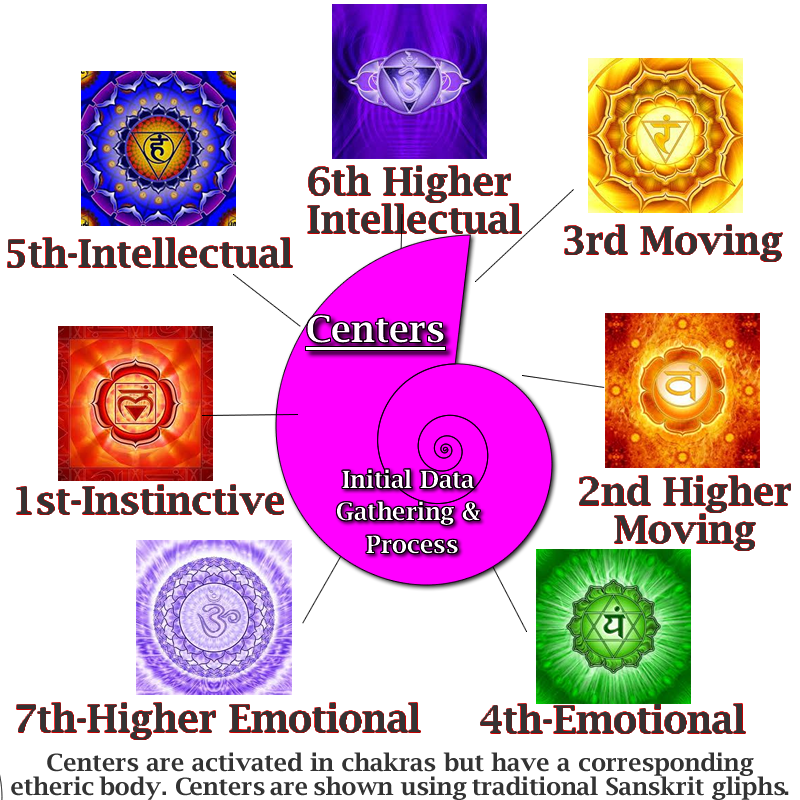
The images for the Centers (above) have been borrowed from the Hindu designation and symbolism.
No Center is “better than” another! No sequence is “superior” to another, either. However, it can be said that various life situations for an individual can make the Essence choose a sequence that it perceives is most needed (or just plain curious). For instance, my (Stephen’s) arrangement of “Trio” is Emotionally-Centered, Intellectual-Part, with the Moving(Physical)-Tertiary. The third is sometimes referred to as the “trap” because of human tendency toward binary actions. This means that a person is liable to get “stuck” bouncing between the Center and Part, and thus omit the 3rd or tertiary process to round out, complete, or be thorough in understanding all the aspects of an experience. In a general analogy, one can consider this process of exclusion or trap, as putting forward a hypothesis (an idea) and then forgetting putting it to the test. Without the completion of the process of evaluating experience through each of the “ordinal” Centers, one will tend to come away with an incomplete conclusion; potentially an erroneous one.
The Centers are etheric. One cannot “touch” them tangibly, but one might certainly be able to feel them energetically, and even notice when that area of their field seems clogged or on the other end open and flowing. These concepts are similar to interpreting the Chakra system posited by Hinduism and also used Buddhism. Auras, Energy Bodies, Meridians, are Dan Tien, are other metaphysical descriptions attempting to explain the invisible energy fields from which the Essence generates vibrations which form the Personality in a body.
The Seven Centers and Related Chakras are:
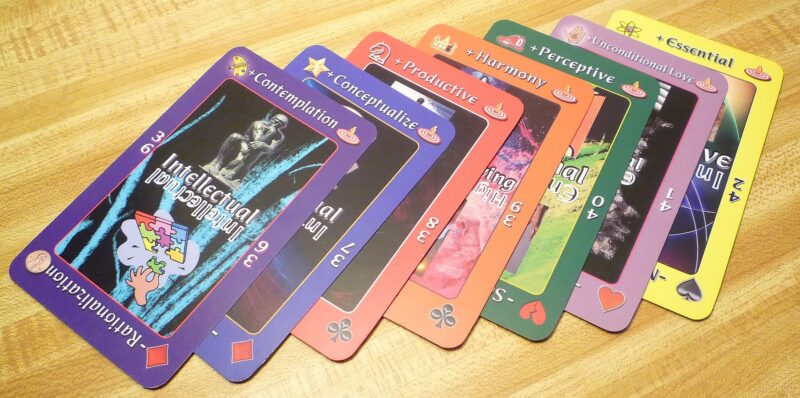
Instinctive Center – 1st Chakra – Card 42
Emotional Center – 4th Chakra – Card 41
Moving/Physical Center – 3rd Chakra – Card 38
Intellectual Center – 5th Chakra – Card 36
Higher Moving – 2nd Chakra – Card 39
Higher Emotional – 7th Chakra – Card 41
Higher Intellectual – 6th Chakra – Card 37
Choosing a Centers Card in a Reading