
The Michael Personality Trait System are called the Overleaves. Within the greater areas addressed in the Michael Teachings subject matter, the Overleaves are metaphysical archetypes that the Essence (Soul) configures and then transmits effects to the Personality (Self). Like some other categorization schemas, they may, like this one inherently assume a connection between a non-physical soul, and a physical body – personality, that also contains an Ego (the animal and subconscious aspect, or ID) e.g. Astrology, Tarot, and Numerology. There are other more recently developed typology systems like Meyers-Briggs (Introversion-Extroversion) Human Design, or Enneagram. And historically, the Greek quadrant of character temperaments: phlegmatic, sanguine, choleric, and melancholic, is one of the first of these typologies to appear.

One problem appropriately proffered in response to typologies is the reduction of the complex nature of the human psyche into neat boxes; somehow limiting uniqueness or enforcing adherence to a theory. For us within the MichaelSphere, there is no such need to restrict or constrain human uniqueness. Instead, these a the essential building blocks, and in various configurations, recipes’ of sorts, that allow for virtually infinite diversity. Yet, it is incumbent upon the individual NOT to limit themselves to strict categorization and jump into restrictive or definitive boxes that constrain your self-awareness. Rather to see them as foundational interpretation upon which your preference and predilections for life and living may be founded.
Ultimately, the Michael Teaching’s Overleaves System establishes an integrated and descriptive frame-of-reference which provides narratives which a cohesive method for self understanding can begin. Overleaves, as used in the Michael Motivation Cards™ (i.e. this web site), are primary elements of this both these Teachings and this feedback divination tool. As you explore the Archetypes of the Overleaves here are the foundational qualitative groups and their 7 variants in each category.
How do the Overleaves appear in the Cards?
The Overleaves characteristics appear from Card 1 through Card 52. As Motivations, these can call up the situational flavors that may be active within you or presented in a circumstance or other persons relevant to your query. Interpreted by knowledgeable practitioners these can assist you in making sense an innate temperament or tendency for various preferences, beliefs, and behaviors.
Overleaf Categories
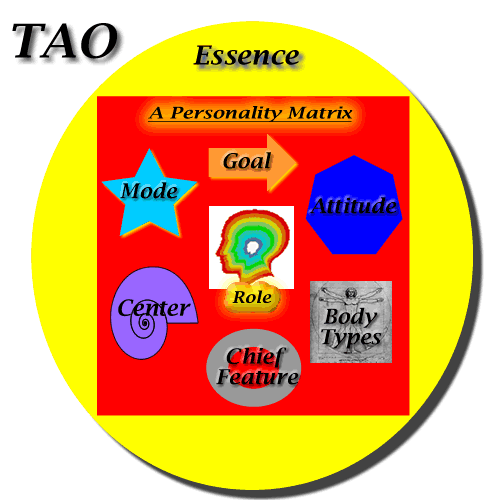
There are seven categories or classifications of Overleaf traits:
Role– The primary frame of reference from which your Essence influences the style of your Personality. Often, the Role will show the world, and perhaps yourself, the most obvious attributes of your character. No role is singularly a job skill. Not every King royalty, nor every Warrior a soldier. However, some of the more defining traits of those types of people, imperious and grand for the King, and loyal and perhaps a need for order might apply.
Goal – The general direction for life learning. A categorical set of experiences by a specific motivation. To some extent, the goal might very well reveal itself by how outgoing the individual is and how diverse. It is here we might see how introversion and extroversion influence the expression of this character set; with introverts tending to lean toward the ordinal Goals: Discrimination (also called Rejection), Reevaluation (formerly called Reevaluation) and Submission; and extroversion the exalted Goals Acceptance, Growth, and Dominance.
Attitude – The dominant mind set or point of view that a person encapsulates all of their thoughts and reasoning. One can think of Attitudes as vertical scale rising up from a base of Cynicism to a height of Spiritualist. The ordinal Attitudes lean toward slowing people’s thinking or putting focus to the near term. Around the middle of the scale Pragmatism and Realist move up the scale while Idealist of human values is just under the Spiritualist. Fear affects these upper attitudes with a greater sense of restriction.
Chief Feature – These represent the primary Ego defenses as generated by fears of loss, lack, inadequacy, or fear of change.
Mode – The method, or the form of behavioral stance one takes toward carrying out the goal.
Centering – The way that a person will primarily process information within themselves.
Body Type – The surface most interactive aspects of the Personality with the physical plane.
These appear in a chart form which is free to download. While some of the features provoke curiosity as to their construction, others might inspire a smile and “ah-ha” when revealed. In fact, what one might notice is the way in which some of these descriptions parallel, historic stereotypes; lending to the notion that every simplification has still captured some common attributes.
Origination of the Overleaves
Since the publication of the first books in 1978, probably several million people or more have come in contact with what I collectively refer to as The Michael Teaching™. During this time there have been 12 books written related to this Cosmology and Personality Trait System. In each, several revisions, clarifications, and updates to the meaning and content of many of the Overleaf Characteristics have been made. What you will read here is a composite of all of those sources and the Channel Stephen Cocconi.
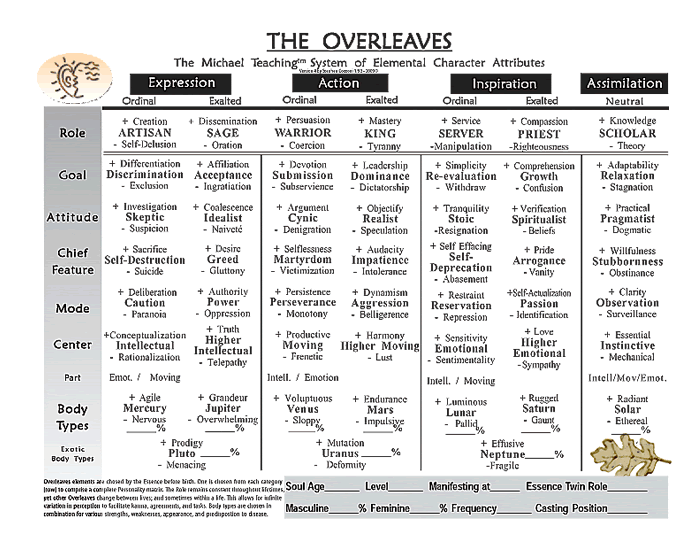
This version v.4 of the Overleaves Chart
This is the fourth generation of the Overleaves Chart. The original was channeled by Sarah Chambers and popularized in the book “Messages From Michael” by Chelsea Quinn Yarbro (although original source material was produced by Sarah Chambers). The second was a collaborative effort by JP Van Hulle, Jose Stevens and Simon Warwick-Smith. It appears in the books “The Michael Handbook” by Stevens and Smith and “Michael, The Basic Teaching” by Van Hulle, Christaean, and Clark. The third generation was done by Emily Baumbach in her book, “Michael’s Cast of Characters.” There is a fifth generation by Shepherd Hoodwin in his book, “Journey of Your Soul.” This fourth generation is the product of Stephen Cocconi and used since January 1992.
Like the other channeled systems, most notably the Enneagram and Astrology, no one owns this material. Instead, each successive generation reflects the input of interpretation and experience that each channel has had in his/her personal and professional life journey.
However, the name “The Michael Teaching” is a registered and copyrighted business name owned by Stephen Cocconi. In no way, does he claim total ownership or complete original authorship to the combined body of knowledge collectively called “the Michael teachings”. Instead, this is merely his brand and business identity.
Why have your Overleaves Channeled?
There is only one reason to do anything including getting your Overleaves read: self knowledge! How? By use of this distinctive, descriptive conceptual system, you can understand much of the native tendencies, perspectives, and habits that you take for granted. Such knowledge can provide useful narratives which offer you greater facility with these characteristics and validation of who you really are. But the most significant reason that most people come for a reading is to get a sense of validation and thereby experience deeper self-acceptance. The peace that this can deliver from Soul to Ego is immense and gratifying. If you were interested in finding out about your Personality Overleaves Matrix, you can contact Stephen Cocconi to inquire about a personal session to do so. Email Stephen Cocconi.
Stephen Cocconi © 2026
